
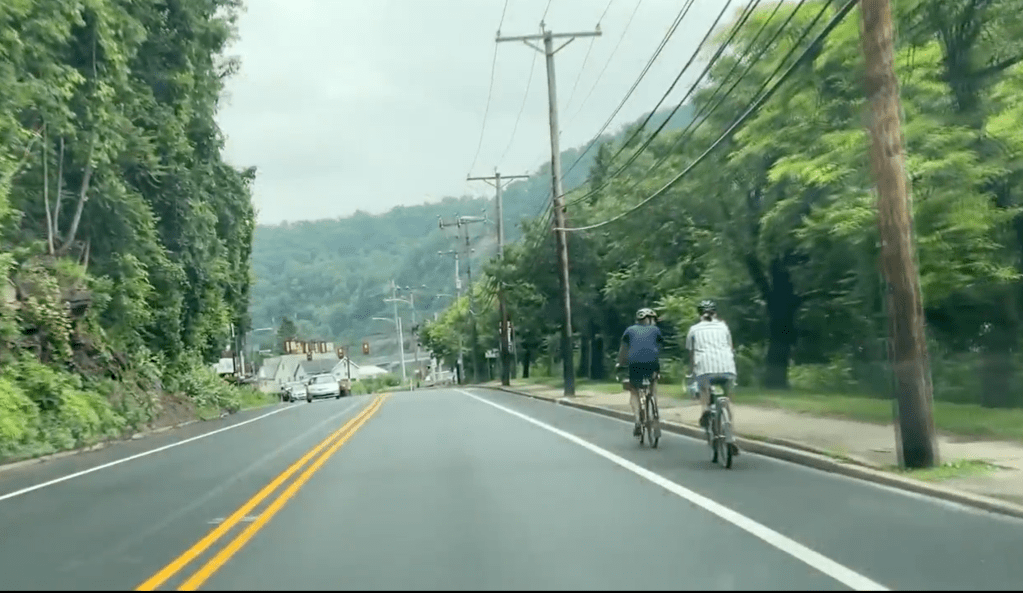
New bike lanes in Johnstown, PA
The Trump Administration is attempting to reverse the progress that we’ve made toward making it safer and easier to walk, take transit and bike. Secretary Duffy’s new “Freedom to Drive” initiative, which is focused on decreasing federal funding for active transportation and increasing capacity for the use of automobiles, will have the opposite effect, while making it more dangerous for those outside of cars to get around.
The CAMP Coalition sent our first letter to Governor Shapiro asking him to continue to support biking and walking infrastructure in Pennsylvania.
Read the letter below.
Dear Governor Shapiro:
I am writing on behalf of the Coalition for Active Mobility in Pennsylvania, a statewide bicycle and pedestrian advocacy group representing everyone who walks and bikes throughout our state. Recently, you received a letter from U.S. Secretary of Transportation Sean Duffy regarding his department’s latest campaign, the “Freedom to Drive” initiative “to tackle the nation’s growing congestion problem.”
As people who are on our roads often – as bicyclists, bus riders, drivers, and pedestrians – we understand the frustrations of traffic congestion. But we believe that Secretary Duffy’s new “Freedom to Drive” initiative will, in an effort to reduce congestion, actually lead to our roads being more congested, less safe, and less accessible to all.
In his letter introducing the “Freedom to Drive”, Secretary Duffy makes recommendations on how to address congestion, including: “Focus solutions on expanding and maximizing roadway capacity for driving. This includes building new roadway capacity or applying operational strategies and technologies to maximize existing roadway capacity. You may also need to recover roadway capacity from other purposes to support driving.” (1)
Real world results and evidence show that bike or bus lanes or pedestrian infrastructure do not increase congestion. Rather, real world results and evidence show that adding vehicle lanes increases congestion due to induced demand. In the same amount of space, bike lanes and bus lanes can move approximately 10 times as many people as the same amount of space allotted to private motor vehicles.
The U.S. Department of Transportation’s Federal Highway Administration (FHWA) itself observes: “Studies have found that roadways did not experience an increase in crashes or congestion when travel lane widths were decreased to add a bicycle lane.”(2) Further, FHWA says, “Studies and experience in U.S. cities show that bicycle lanes increase ridership and may help jurisdictions better manage roadway capacity.” (3)
While Secretary Duffy’s letter cites the “economic burden” of $269 billion in lost productivity due to traffic congestion, a real imperative should be addressing the $1.4 trillion in societal harm due to traffic crashes and the more than 40,000 people who die in traffic violence every year (4), including 1,047 in Pennsylvania last year. Secretary Duffy’s analysis based solely on delay is not compelling.
Your administration has been focused on the real economic burdens – the high cost of childcare, low wage jobs, and affordability generally. Every family that can swap a car or delay a car purchase with an e-bike is a triumph for affordability. Every walking trip that would otherwise have to be a taxi is a win. Your administration’s continued support of active transportation infrastructure is key to that. You cannot control whether the federal administration starts foreign wars that raise gas prices, but you can control whether Pennsylvanians have safe, viable, low cost alternatives to driving.
Bike lanes don’t make congestion worse. They reduce crashes, which cause 25% of road congestion, and they save lives (5). As noted by USDOT, adding a bike lane to a road can reduce crashes up to nearly 50% on a 4-lane urban road and up to 30% on a 2-lane urban road (6). Given the economic and human toll of vehicle crashes, bike lanes are an incredibly cost-effective and evidence-based way to enhance roadway safety for all users.
Pennsylvania has been the beneficiary of more than $469.1 million (7) in federal funding for bicycling and walking infrastructure through the Transportation Alternatives program. Communities like Erie, Bethlehem and Lancaster among others have received Safe Streets and Roads for All implementation grants to improve the safety of all road users. Projects like these – ones that make it safer and easier to bike and walk instead of contributing to congestion by driving – are also a boon to local economies. In 2024, bicycling activity alone accounted for over $251.1 million in value added to Pennsylvania’s GDP (8).
Thank you for your leadership to date on making our roads safer, through projects like these. PA roads saw their lowest fatalities since records began being kept. That said, bicyclist fatalities are up nearly 50% from 2024 and pedestrian fatalities, while improving, are still higher than they were pre-pandemic. Secretary Duffy’s initiative will only exacerbate this.
Our neighboring states – New York, Maryland (9), New Jersey (10), and even Ohio (11) have recently redoubled their efforts to support active transportation with on-street infrastructure. This, as you know, is no time to lose momentum.
Our communities are at their best when Main Street businesses are bustling with foot and bike traffic, when block parties are bringing neighbors together, when thousands are flocking to America’s birthplace on Independence Day – when families have choices on how they get around their communities. We hope you will continue to build infrastructure that makes your communities safe and accessible for everyone, whether walking, biking, taking transit or driving.
Please reach out if you have any questions about how to make our great commonwealth even better for bicycling and walking.
Sincerely,

Scott Bricker
Executive Director, BikePGH
On behalf of the Coalition for Active Mobility in PA
Cc: Secretary Mike Carroll
Deputy Secretary for Multimodal Transportation Meredith Biggica
- “Freedom to Drive.” USDOT. https://ops.fhwa.dot.gov/freedom-to-drive-initiative.htm. Accessed 27 April 2026.
- “FHWA Highway Safety Programs. Proven Safety Countermeasures. Bicycle Lanes.” USDOT. https://highways.dot.gov/safety/proven-safety-countermeasures/bicycle-lanes. Accessed 27 April 2026.
- Ibid.
- “NHTSA’s National Center for Statistics and Analysis. Summary of Motor Vehicle Traffic Crashes: 2023.” USDOT. https://crashstats.nhtsa.dot.gov/Api/Public/ViewPublication/813762. Accessed 27 April 2026.
- “Federal Highway Administration, Office of Operations. Reducing Non-Recurring Congestion.” USDOT. ops.fhwa.dot.gov/program_areas/reduce-non-cong.htm. Accessed 27 April 2026.
- FHWA, “FHWA Highway Safety Programs. Proven Safety Countermeasures. Bicycle Lanes.”
- SRTS TAP Apportionments by State 2013-2026 https://saferoutespartnership.org/wp-content/uploads/2026/05/TAP-Annual-Apportionments-by-State-FY13-to-Present.pdf
- Outdoor Recreation Satellite Account State Summary Sheet: Pennsylvania, 2024 (pp. 1–2). (2026). U.S. Bureau of Economic Analysis. https://apps.bea.gov/regional/outdoor-recreation/pdf/Pennsylvania2024.pdf
- “Baltimore Region Transit Oriented Development Strategy: April 2026.” MDOT. https://www.mdot.maryland.gov/ORED/BMORE-TOD-Strategy-Report.pdf. Accessed May 8, 2026.
- 2026 NJDOT Complete Streets Summit. https://njbikeped.org/2026-njdot-complete-streets-summit-agenda/. Accessed May 8, 2026.
- “Economic Impact of a Walkable and Bikeable Ohio: 2025.” ODOT. https://dam.assets.ohio.gov/image/upload/transportation.ohio.gov/safety/highway-safety/active-transportation/Economic-Study-Full.pdf. Accessed May 8, 2026.


Leave a Reply